
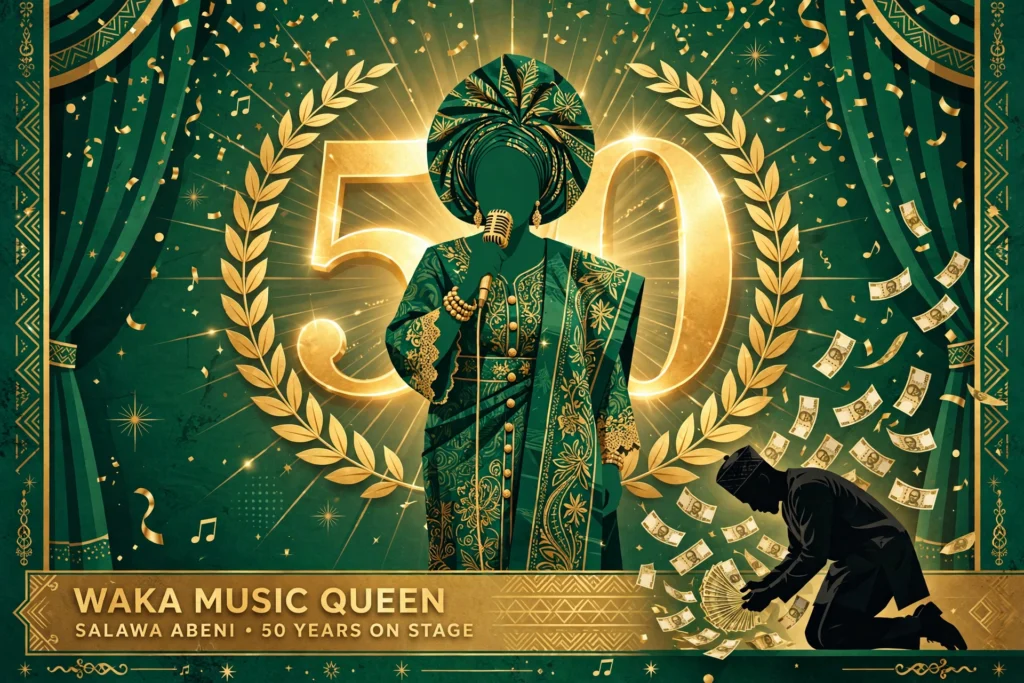
Salawa Abeni at 50 Years on Stage: King Saheed Osupa Bows Before the Waka Queen as MC Oluomo Gifts Her a Car at Lagos Golden Jubilee
There are concerts, and then there are coronations. On Sunday, October 18, 2026, the Oriental Hotel on Victoria Island, Lagos, hosted the latter. Queen Salawa Abeni, the undisputed Queen of Waka Music, celebrated 50 years on stage with a golden jubilee concert organised by Lahmad Concepts, and the night delivered moments that have since set Nigerian social media ablaze. Fuji star King Saheed Osupa bowed before the living legend and sprayed her with money on stage, while NURTW leader MC Oluomo stunned the audience by gifting her a car right in the middle of her performance. For an artiste who has given Nigeria half a century of music, it was a tribute worthy of her name.
A Golden Jubilee 50 Years in the Making
The evening was conceived as more than a concert; it was a celebration of survival, artistry and cultural heritage. From the moment the lights dimmed at the Oriental Hotel, the atmosphere carried a sense of history. The night opened with a nostalgic journey through Salawa Abeni's catalogue, stretching all the way back to 1976, the year her debut album, "Late General Murtala Ramat Mohammed," introduced her voice to Nigeria. The audience — drawn from the music industry, Nollywood, the corporate world and government circles — sang along to songs that have soundtracked five decades of Nigerian life.
For those unfamiliar with the arc of her career, the numbers alone command awe. Salawa Abeni is 65 years old, and she has spent 50 of those years on stage. She entered a musical landscape dominated by men and, through sheer talent and determination, carved out not just a space but a throne. Her brand of Waka music, deeply rooted in Yoruba Islamic vocal traditions, became a cultural movement in its own right, and she remains its most recognisable ambassador.
The Night King Saheed Osupa Bowed Before the Queen
Of all the moments that defined the golden jubilee, one has dominated conversations across Nigeria: King Saheed Osupa, one of the biggest names in Fuji music, stepped onto the stage, bowed deeply before Salawa Abeni, and sprayed her with money in the full glare of the audience. The gesture was spontaneous, public and loaded with meaning, and fans across the country have not stopped talking about it.
To understand why this moment struck such a chord, one must understand the cultural weight of bowing in Yoruba tradition. To bow is to show deference; to bow before an elder, and on her own stage, is to publicly acknowledge her supremacy. Osupa, a star in his own right with decades of success behind him, set aside ego and rank to honour a living legend. It was a gesture that transcended the boundaries between Fuji and Waka, two genres that share deep roots in Yoruba musical culture, and it reminded everyone present that respect is the true currency of the industry.
Spraying money — the rain of naira notes on a performer — is itself one of the most enduring traditions of Nigerian celebration culture. From weddings to chieftaincy ceremonies to concerts, spraying is how Nigerians say, "We see you, we celebrate you, we honour you." To be sprayed by a fellow star of Osupa's calibre, while being bowed to, elevated the moment into something rare: a masterclass in public honour. Fans on social media praised the gesture as the kind of humility the industry needs, noting that legends acknowledging legends keeps the culture alive.
MC Oluomo's Surprise Car Gift Stops the Show
If the Osupa moment was the emotional peak, MC Oluomo's gesture was the shock of the night. Mid-performance, the NURTW leader walked onto the stage, leaned in and whispered something into Salawa Abeni's ear. Moments later, she took the microphone and announced to the cheering crowd that he had gifted her a car. The hall erupted. Supporters screamed, cameras flashed, and the performance continued with a renewed energy that carried the rest of the evening.
The gift was significant for reasons beyond its monetary value. In Nigerian entertainment culture, big gestures of appreciation for veteran artistes carry deep symbolism. They say that the industry does not forget its own, that five decades of service to music translate into real, tangible honour. For a woman who has weathered personal storms in public, the car gift was also a public affirmation: her legacy is secure, her contributions recognised, and her people stand with her.
Waka Music and the Trailblazer Who Carried It
To appreciate the magnitude of a 50-year celebration, one must understand Waka music itself. Waka is a Yoruba vocal tradition with Islamic roots, characterised by poetic lyrics, call-and-response patterns and percussion that drives both celebration and reflection. For much of its history, it was a genre where men held the microphone and women were expected to listen. Salawa Abeni changed that — permanently.
When she released her debut album in 1976, she was not merely launching a career; she was breaking a barrier. She became the first woman to record in the genre's modern commercial form, and her success opened doors for generations of female artistes who followed. The title "Queen of Waka Music," conferred on her in 1992 by the late Alaafin of Oyo, Oba Lamidi Adeyemi, was not an honorary flourish. It was a coronation by one of Yorubaland's most revered monarchs, and it sealed her place in the cultural pantheon.
Over five decades, her music has chronicled Nigerian life: its joys, its politics, its faith, its struggles. Her songs have been played at weddings, naming ceremonies, political rallies and quiet Sunday mornings. She became, in every meaningful sense, the voice of a generation — and then the generation after that, and the one after that.
Trials That Tested the Queen — and Made Her Stronger
Fifty years on stage was never guaranteed. Salawa Abeni's life has carried trials that would have ended lesser careers, and her willingness to speak about them has made her a figure of inspiration far beyond music.
She has spoken openly about the death of a son, a grief no parent ever fully recovers from. She endured a five-year period of paralysis that kept her away from the stage she loved. And in one of the most dramatic moments of her career, she once vomited blood on stage — yet kept performing. These are not stories she tells for sympathy; they are testimonies of endurance, offered as proof that destiny does not negotiate with suffering.
Her personal life has also been lived in the public eye. She has been married three times, and she has reflected on those chapters with characteristic candour. "I tried to be a wife, but my destiny was music," she said in a recent reflection, adding that each of her three marriages taught her lessons she carries to this day. In a culture where female celebrities are often judged harshly for failed marriages, her honesty has been refreshing — a woman owning her story on her own terms, unapologetic about the path that made her a queen.
A Year of Honours for the Waka Legend
The golden jubilee concert caps a remarkable year of recognition for Salawa Abeni. In October of last year, she was honoured at Ariya Eko, the Evergreen Music celebration organised with the Lagos State Government, where her contributions to Nigerian music were formally celebrated. That honour, followed now by a 50th-anniversary concert drawing the industry's biggest names, confirms what her fans have always known: the Queen's reign is not nostalgia. It is a living, breathing legacy.
The guest list at the Oriental Hotel told its own story. Music industry executives, Nollywood stars, corporate leaders and government figures all turned up — a cross-section of Nigerian society united by one woman's music. It was a reminder that true legends do not belong to one industry or one generation. They belong to the nation.
Why This Night Matters for Nigerian Music
There is a temptation to treat concerts like these as mere entertainment. That would miss the point. The Salawa Abeni golden jubilee was a cultural event of national significance, for several reasons.
First, it celebrated longevity in an industry that too often discards its veterans. Nigerian entertainment moves fast, and yesterday's stars can become today's footnotes. A 50-year celebration, attended by the industry's current power brokers, sends a message: we honour our own, and we do it while they are here to receive the flowers.
Second, the Osupa moment modelled something the industry desperately needs — public, unforced respect between stars of different generations and genres. In an era of social media rivalries and manufactured beef, a genuine bow on stage is revolutionary.
Third, the night reaffirmed the place of indigenous music in modern Nigeria. Waka may not dominate the Afrobeats charts, but its cultural roots run deeper than any trend. Salawa Abeni's five decades prove that music rooted in language, faith and tradition does not expire. It endures, it evolves, and it crowns its queens.
As the final notes faded at the Oriental Hotel and the crowd filed out into the Lagos night, one truth was undeniable: Salawa Abeni did not just survive 50 years on stage. She conquered them. And on a Sunday night in October 2026, Nigeria bowed — with her.
Source: Legit.ng, Mockinbird, Tribune Online